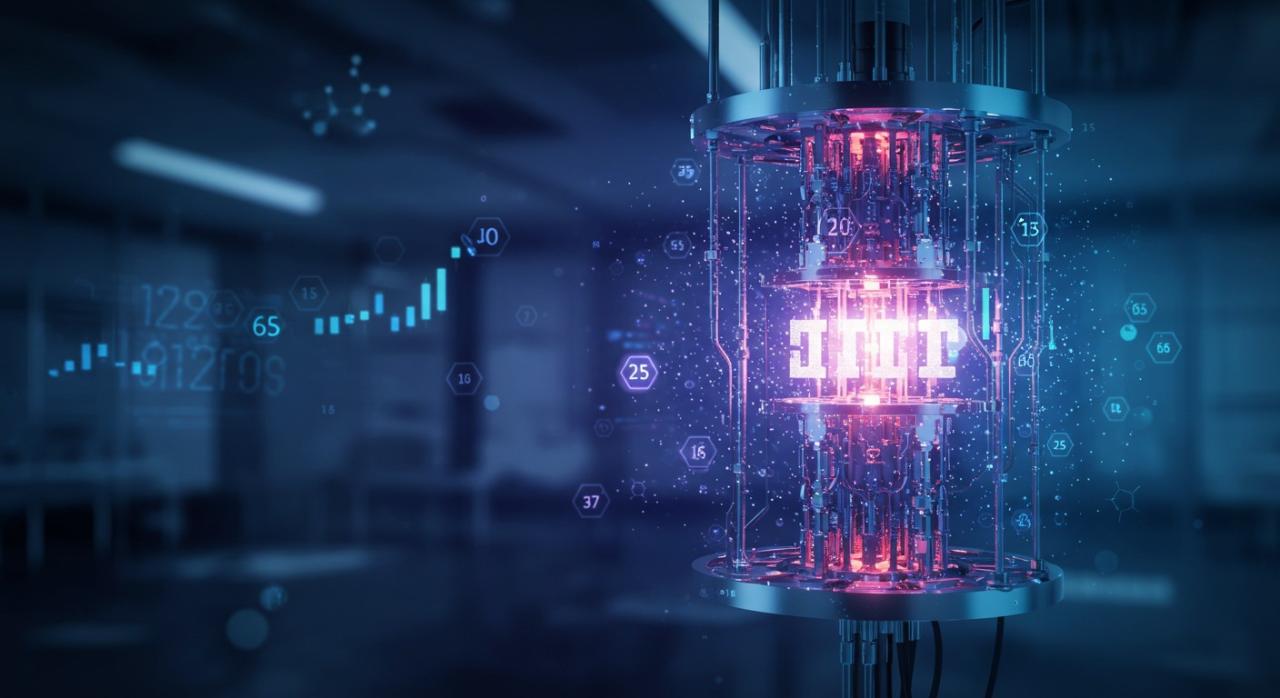
The landscape of computational power stands on the precipice of a monumental transformation. For decades, the theoretical promise of quantum computing has tantalized scientists and industries alike, offering a future where problems intractable for classical supercomputers could be solved in minutes. However, the path from theory to practical, reliable application has been fraught with a fundamental, persistent obstacle: error. In a development sending ripples through the scientific and technological communities, a multi-institutional research consortium has announced a breakthrough that directly addresses this core challenge. This advancement is not merely an incremental step; it represents a pivotal leap toward stable, fault-tolerant quantum computation, potentially accelerating our timeline to a quantum-powered future by years.
This breakthrough centers on a sophisticated and highly effective method for quantum error correction (QEC). Unlike classical computers, where bits exist as definitive 0s or 1s, quantum computers use quantum bits or qubits. Qubits leverage the quantum mechanical principles of superposition (existing in multiple states at once) and entanglement (a profound connection between particles). This is what grants quantum computers their phenomenal potential for parallel processing. However, this same sensitivity makes qubits exquisitely vulnerable to interference from their environment—be it temperature fluctuations, electromagnetic noise, or even cosmic rays. This “decoherence” and other operational errors have, until now, made sustained, complex calculations prone to failure, akin to trying to complete a delicate symphony while the orchestra is constantly buffeted by chaotic winds.
The newly announced research has successfully demonstrated a QEC code that suppresses errors faster than they occur, a key milestone known as achieving “quantum logical advantage.” Previous attempts often saw the error correction process itself introducing new errors, a self-defeating cycle. This new paradigm utilizes a multi-layered architecture of physical qubits to create a single, more stable “logical qubit.” Think of it as constructing a durable, error-resistant vessel (the logical qubit) from numerous fragile, error-prone components (the physical qubits), guided by a real-time, adaptive correction protocol. The team reported a record-breaking reduction in logical error rates, surpassing the all-important threshold where correction outpaces error generation. This successful demonstration was achieved on a processor featuring a novel qubit array design, enhancing connectivity and control fidelity.
A. The Quintessential Problem: Why Quantum Errors Are So Formidable
To appreciate the magnitude of this achievement, one must delve deeper into the nature of the quantum error problem.
A. The Fragility of Superposition: A classical bit is like a sturdy light switch—firmly on or off. A qubit in superposition is like a perfectly balanced spinning coin, embodying both “heads” and “tails” simultaneously. Any minuscule interaction can collapse this delicate state into a definitive 0 or 1, destroying the quantum information.
B. The Menace of Decoherence: This is the process by which a qubit loses its quantum properties to the environment. It’s the primary reason quantum processors must operate at temperatures colder than deep space. Extending “coherence time” is a constant battle.
C. Gate Operation Imperfections: Performing calculations on qubits involves quantum logic gates. These operations are not perfectly precise, and each minor inaccuracy compounds, leading to computational drift.
D. The No-Cloning Theorem’s Constraint: A pivotal quantum rule states that an arbitrary quantum state cannot be perfectly copied. This prevents the use of simple classical redundancy methods (like making three copies of a bit) for error correction, necessitating far more ingenious QEC strategies.
B. Deconstructing the Breakthrough: The Architecture of Stability
The announced method integrates several cutting-edge concepts into a cohesive and robust system.
A. Topological QEC Codes: The approach is believed to utilize a form of surface code or topological code. Here, logical qubits are defined not by a single physical element but by the collective state of a lattice of physical qubits. Errors manifest as detectable “excitations” on this lattice. The specific innovation lies in the efficiency of the parity-check measurements and the lattice connectivity, allowing for quicker error detection and localization.
B. Real-Time Adaptive Correction: Instead of applying static correction routines, the system employs machine learning algorithms to analyze error syndromes in real-time. This adaptive feedback loop predicts and preemptively adjusts for error chains, preventing small errors from proliferating.
C. Improved Qubit Fabrication: The breakthrough was enabled by simultaneous progress in qubit quality. The researchers utilized a new generation of superconducting qubits with significantly longer intrinsic coherence times and a reduced crosstalk architecture. This means the raw material—the physical qubits—were more stable to begin with, providing a stronger foundation for the error correction framework.
D. Scalable Control Systems: Managing the multitude of signals required to control and read hundreds of qubits without interference is a Herculean task. The team unveiled a new cryogenic control chip that operates in the extreme cold alongside the processor, minimizing thermal noise and signal latency, which is critical for timely error correction.

C. The Ripple Effect: Implications Across Industries
The successful taming of quantum errors unlocks doors to practical applications that were previously theoretical exercises.
A. Drug Discovery and Materials Science: Quantum computers could simulate molecular and quantum mechanical interactions with perfect fidelity. This would allow for the rapid design of new pharmaceuticals, catalysts, superconductors, and battery electrolytes, moving from trial-and-error laboratory processes to precise digital simulation.
B. Cryptography and Cybersecurity: The much-discussed threat to current public-key encryption (like RSA) from quantum algorithms such as Shor’s becomes more imminent with stable quantum processors. This breakthrough accelerates the timeline, making the global transition to post-quantum cryptography an urgent imperative for governments and corporations.
C. Optimization and Logistics: From managing global supply chains and air traffic to optimizing financial portfolios and energy grids, many of the world’s most complex optimization problems are ideal targets for quantum algorithms. Stable computation could yield solutions saving billions in costs and resources.
D. Artificial Intelligence and Machine Learning: Quantum computing has the potential to exponentially speed up training times for complex AI models and discover novel neural network architectures, potentially leading to significant leaps in machine intelligence and data pattern recognition.
D. The Road Ahead: From Laboratory to Data Center
While transformative, this breakthrough is a beginning, not an end. The journey from a stable logical qubit to a full-scale, fault-tolerant quantum computer with thousands of logical qubits presents its own set of formidable challenges.
A. The Resource Overhead: Current QEC codes require many physical qubits (potentially 1000 or more) to create a single reliable logical qubit. Scaling to a system capable of practical tasks like breaking encryption would require millions of physical qubits. The next frontier is developing more qubit-efficient codes and continuing to improve qubit density and integration.
B. Cryogenic and Control Infrastructure: Housing a million-qubit processor and its associated control systems presents an engineering nightmare in terms of cooling, wiring, and power management. Innovations in cryogenics, photonic interconnects, and modular quantum processor design will be critical.
C. Algorithm and Software Development: Hardware is only half the equation. The ecosystem of quantum algorithms, programming languages (like Q# and Cirq), and debugging tools must mature in parallel. Developers need stable platforms to write and test the software that will harness this new power.
D. The Hybrid Computing Model: For the foreseeable future, the most powerful computational paradigm will likely be a hybrid of classical supercomputers and quantum accelerators. Determining how to best partition problems between classical and quantum resources is a major area of ongoing research.
The announcement of this quantum error correction breakthrough is a watershed moment. It shifts the conversation from “if” we can build a reliable quantum computer to “when” and “how fast.” It validates decades of theoretical work and provides a clear, demonstrated path forward. It assures investors and industries that the quantum computing project is not a scientific fantasy but a tangible engineering challenge being systematically overcome. As researchers now turn to the problems of scaling and integration, the world must prepare for the accelerating pace of change. The quantum future, once a distant horizon, is now coming sharply into focus, promising to reshape our technological capabilities in ways we are only beginning to comprehend. This is more than a scientific paper; it is the sound of a new chapter in human computation being written.